

When the processes running on your machine attempt to allocate more memory than your system has available, the kernel begins to swap memory pages to and from the disk. This is done in order to free up sufficient physical memory to meet the RAM allocation requirements of the requestor.
Excessive use of swapping is called thrashing and is undesirable because it lowers overall system performance, mainly because hard drives are far slower than RAM.
If your application needs to use a large amount of data, you will be exposed to thrashing and your application could slow down dramatically. Two solutions exist: either optimize your application to use memory more efficiently, or add more physical RAM to the system.
Let’s discover which solution Doxygen uses to optimize its memory usage and avoid the thrashing problem.
Doxygen is the de facto standard tool for generating documentation from annotated C++ sources, but it also supports other popular programming languages such as C, Objective-C, C#, PHP, Java, Python, and many others. Thanks to Dimitri van Heesch for his great effort in developing and maintaining the project.
Doxygen takes the source files as input, parses them to extract the needed data, and stores the result in class instances of the DirDef, FileDef, NamespaceDef, ClassDef, and MemberDef kinds. All of them inherit from the Definition class.
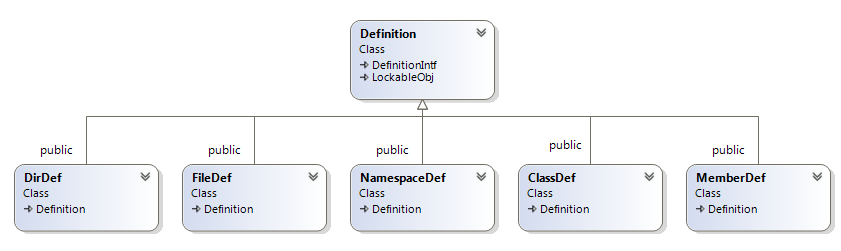
The instances of these classes will then be used to generate the documentation. The data consuming the most memory concerns the information about methods and variables, which is represented by the MemberDef class; the size of these instances can grow to more than 1 GB, depending on the number of methods and variables in the projects processed.
For some projects, storing all these instances in memory will impact system performance, and generating the documentation could take many hours.
How does Doxygen optimize memory?
Doxygen uses a cache-based solution; using a cache is a popular way to optimize your memory usage. The idea is to store in a cache the data that needs to be in memory; this cache contains many slots, each one holding a specific piece of data, and some slots are released if the cache size exceeds a certain value. The released data is moved to disk, and if we need it again, it is moved back to memory.
In the case of Doxygen, the algorithm is very simple:
- Define a cache with 65,535 slots.
- When a MemberDef instance needs to be created, Doxygen checks if a cache slot is available; if so, the instance is created in memory, otherwise it is stored in a data file on disk, and an index file is updated to record where in the data file this data is stored.
- If Doxygen needs to access a MemberDef instance, it checks its presence in the cache. If it’s not present, Doxygen gets from the index file where its data is stored, seeks to that position in the data file, and loads it from disk.
The performance of the cache depends on:
- The container: it could be a queue, an array, a list or maybe a custom container. The choice of one of these containers can impact your cache performance.
- The maximum size of the cache.
- The algorithm used to free entries from the cache. When the cache reaches its maximum, you have to decide which entries to release; for example, you could:
- Release the first slots loaded.
- Release the last slots loaded.
- Release the least-used slots.
1. The Container
Doxygen defines the ObjCache class, which is a linked list of CacheNode objects; this class is responsible for adding and removing instances from the cache.
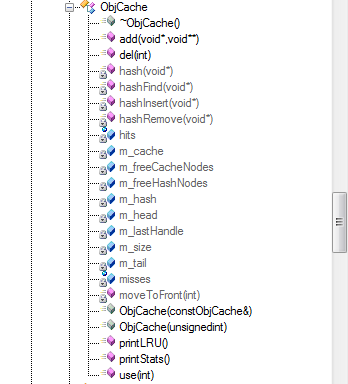
Here’s how Doxygen declares its cache:
Doxygen::symbolCache =new ObjCache(16+cacheSize);// 16 -> room for 65536 elements, 2. Cache size
Doxygen gets the cache max size from the configuration file:
int cacheSize =Config_getInt("SYMBOL_CACHE_SIZE");It’s a good idea to make this parameter configurable, so you can increase the cache if you have a machine with a large amount of physical memory, to improve cache performance. However, in the newer Doxygen releases, this parameter has been removed from the configuration file, and a default value is used.
3. The algorithm for releasing entries from the cache
Here’s the code snippet from the Doxygen source code responsible for releasing cache entries when it reaches its maximum:
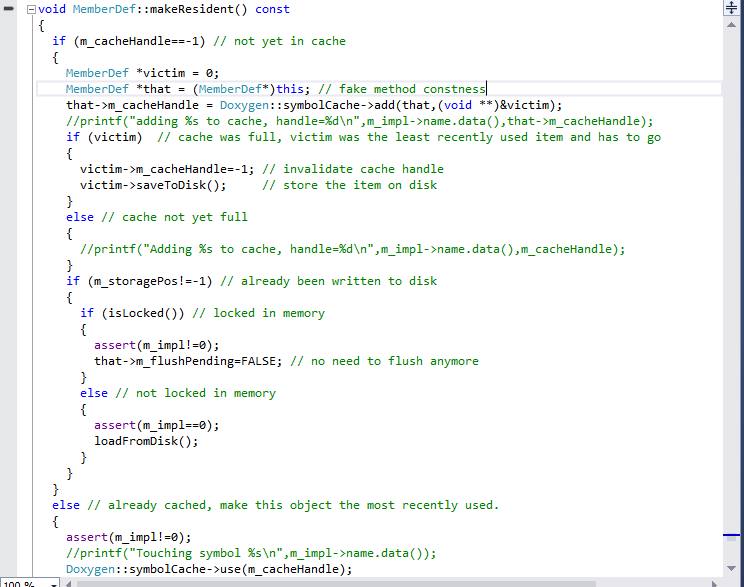
As specified in the makeResident method code, which is very well commented, the least recently used item is removed if the cache is full.
This method is invoked for almost all MemberDef methods, it’s called each time you have to access the MemberDef state to check if this member is loaded or not. Load it if it’s not the case and remove the least recently used member from the cache.
The impact of using the cache
Using a cache can increase the performance of your application, but does caching bring a big optimization, or just a micro-optimization that’s not worth adding to your application?
Before using Clang as the C/C++ parser for our product, we used Doxygen as the parser for our first version, and we ran many tests on cache size. When we disabled the cache and parsed some C++ projects with this modified version, the parsing time increased significantly — sometimes from 5 minutes to 25 minutes. For big projects it took hours and heavily impacted system performance.
Conclusion
Using a cache is a powerful solution to increase the performance of your application if you handle a large amount of data. Discovering how open source projects implement caching can be very useful to understand how to implement it in your own applications.