

Over the past few years, the Godot Engine has emerged as the darling of the indie game development world. Born as an open-source alternative to monolithic commercial engines, Godot won over developers with its tiny binary footprint, instant startup times, and intuitive node-based architecture. To its community, Godot stands as a masterclass in clean, lightweight, and approachable software design.
Go inside Godot using CppDepend
Because Godot uses SCons as its build system instead of standard Visual Studio solutions (.sln), the most accurate way to analyze it in CppDepend is by generating a Compilation Database (compile_commands.json). This tells CppDepend the exact compiler flags, include paths, and macro definitions used during compilation.
1. Generate compile_commands.json with SCons
Open your terminal in the Godot source root folder and run SCons with the compilation database flag enabled:
scons dev_build=yes compiledb=yes2. Create a new CppDepend project and analyze the created json file
After the analysis we have this summary of the project code quality:
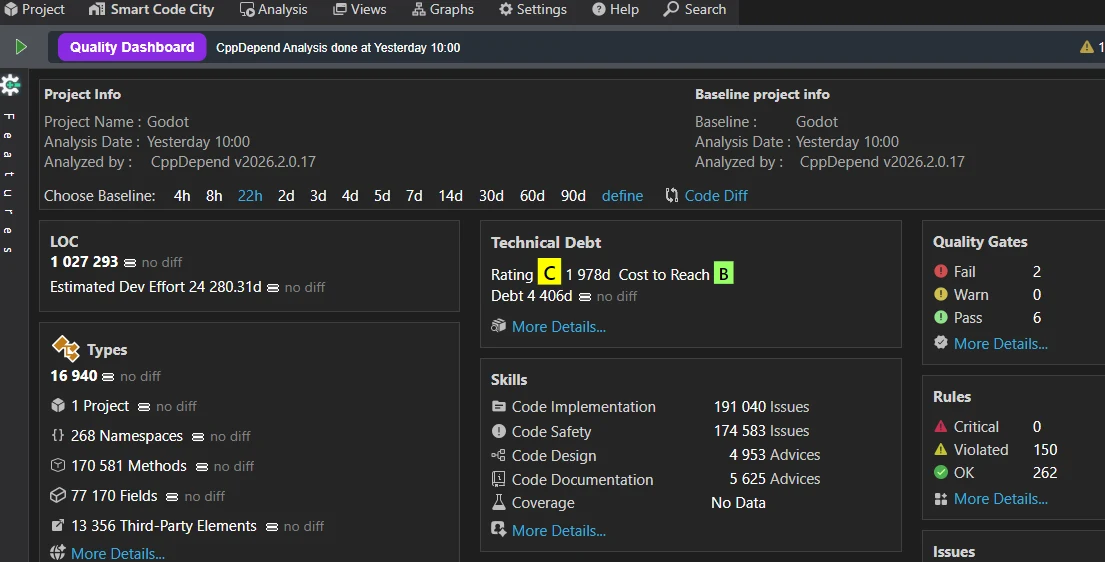
How can an open-source engine celebrated for its tiny binary footprint and rapid compilation receive a C rating? The explanation lies in rule profile configuration.
1. Safety Rules vs. Engine Realities
By default, many analysis profiles enable strict MISRA C++ rules—standards designed for safety-critical systems like aerospace avionics or automotive braking units.
In game engine development, enforcing MISRA generates massive noise:
- Forbidden C-Style Casts (Rule 5-2-4): Flagged thousands of times across low-level rendering pipelines and memory allocators.
- Restricted Pointer Arithmetic (Rule 5-0-15): Blocks custom memory buffers used for CPU-to-GPU mesh streaming.
Disabling MISRA Rules
Removing safety-critical embedded rules to evaluate Godot against general C++ maintainability standards transforms the metrics:
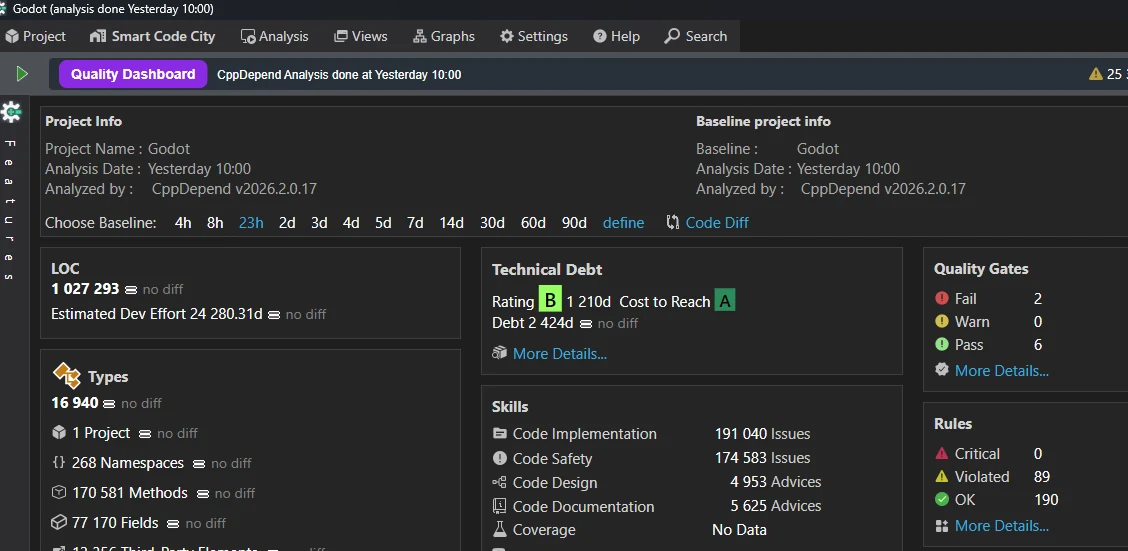
The rating is now B, with only 89 violated rules, down from 150 before.
2. Exploring Godot as Code City
After evaluating the summary dashboard, we can visually explore where the code can be optimized using the Code City feature. Visualizing the codebase as a 3D Code City provides immediate visual insights into coupling, hotspots, code smells, method sizes, and issue distributions.
In this Code City, each building represents a C++ method, while the color indicates health and issue severity. Hovering over any building yields detailed diagnostic metrics.
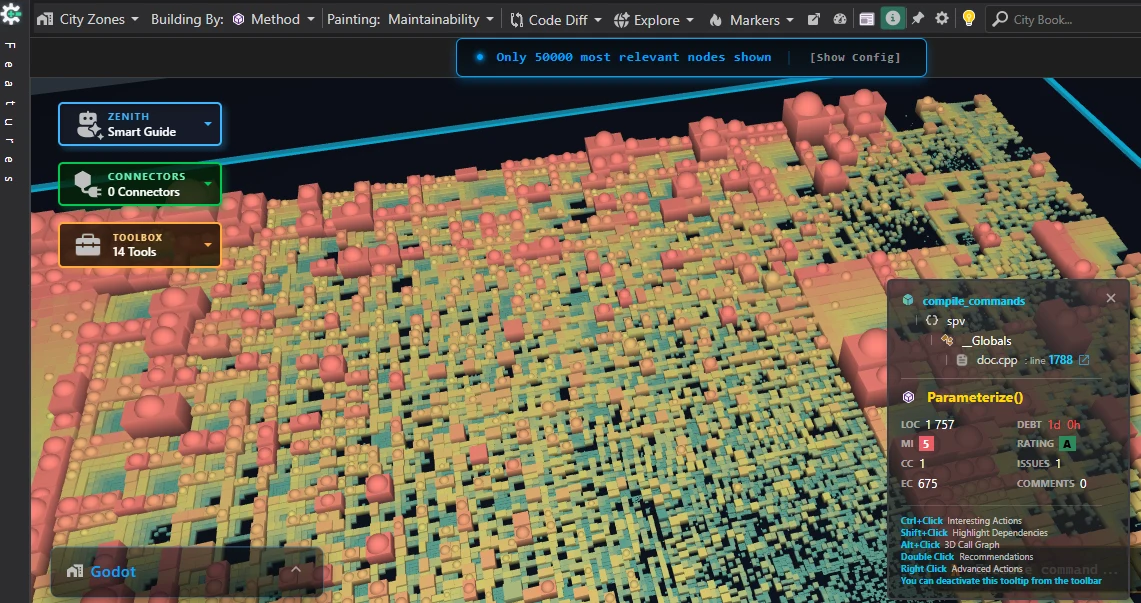
Why Are Many Methods Red?
Looking at hotspot methods like Parameterize(), we find large red buildings flagged with only 1 issue: a violation of the “Too Big Methods” rule. The same pattern applies across many other red structures in the city, where the Issues Explorer highlights localized code smells:
- Monster Methods: Single functions spanning hundreds of lines to handle complex state setups.
- High Cyclomatic Complexity: Deeply nested conditional logic managing API variations across platform backends.
As the Issues Explorer shows, many code smells are detected:
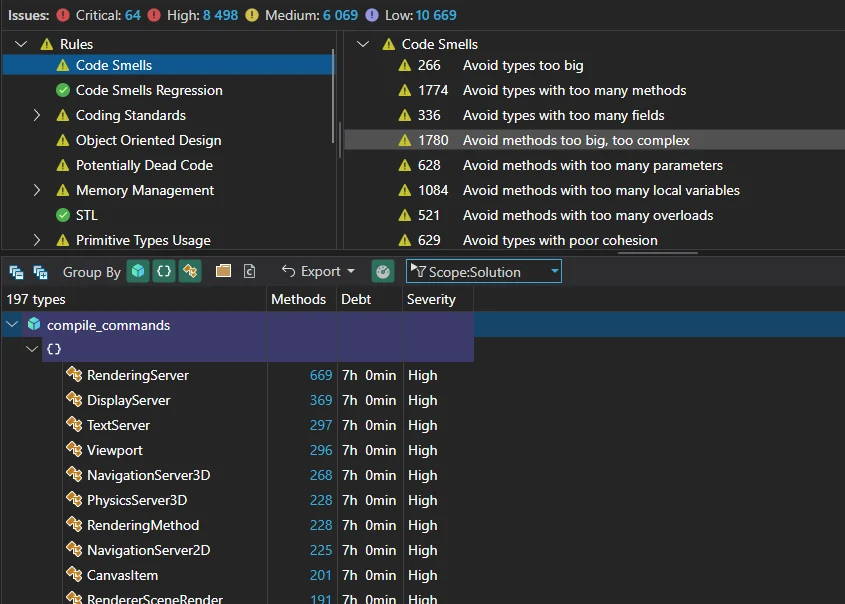
Crucially, these complex methods have low defect rates. They represent well-tested core routines (such as shader parsing or physics dispatch) where high complexity is localized. The primary concern is maintainability rather than active bugs.
3. Structural Design: Modularization, POD Structs, and Massive Abstract Interfaces
Analyzing Godot's design reveals strong structural modularization across core components.
Modularization with Namespaces
Godot makes extensive use of namespaces to modularize its codebase. Subsystems (Rendering, Physics, Audio, Display) are separated into clear module boundaries.
Here are some of the namespaces in the Godot project:
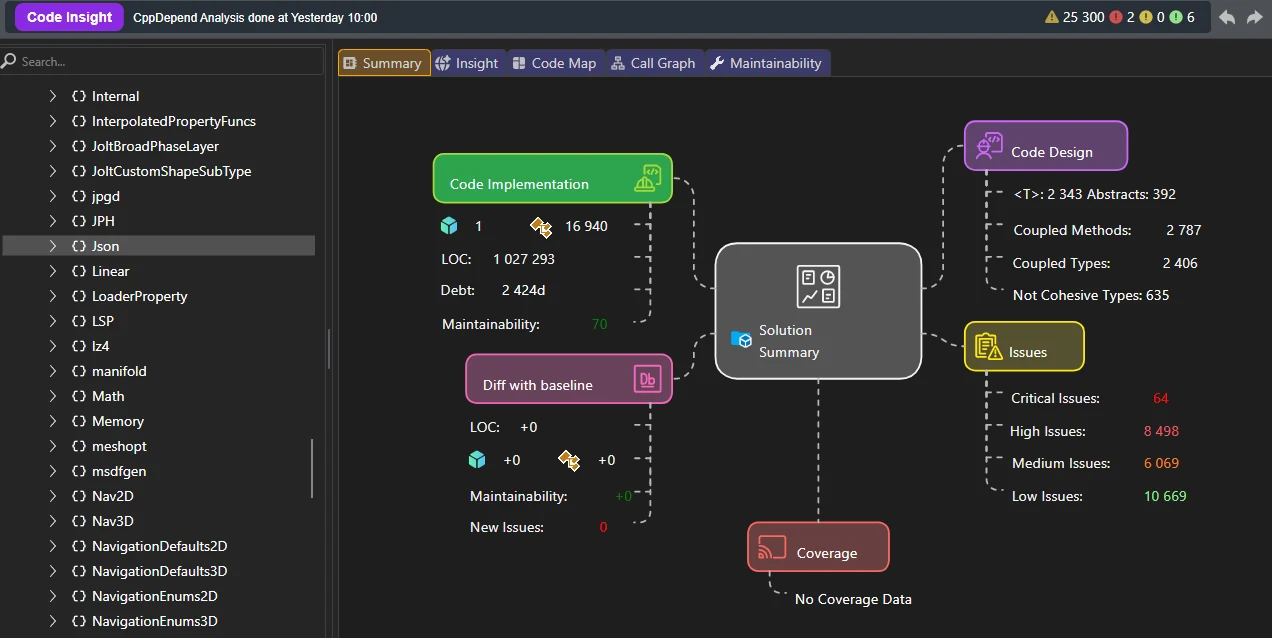
Godot uses the “Namespace-by-feature” approach. Namespace-by-feature uses namespaces to reflect the feature set. It places all items related to a single feature (and only that feature) into a single namespace. This results in namespaces with high cohesion and high modularity, and with minimal coupling between namespaces. Items that work closely together are placed next to each other.
Anonymous namespaces are also used to avoid the need for global static variables. The anonymous namespace you create is only accessible within the file you created it in.
Define the data model as POD types
Let’s search for the POD types using the Code Quest feature:
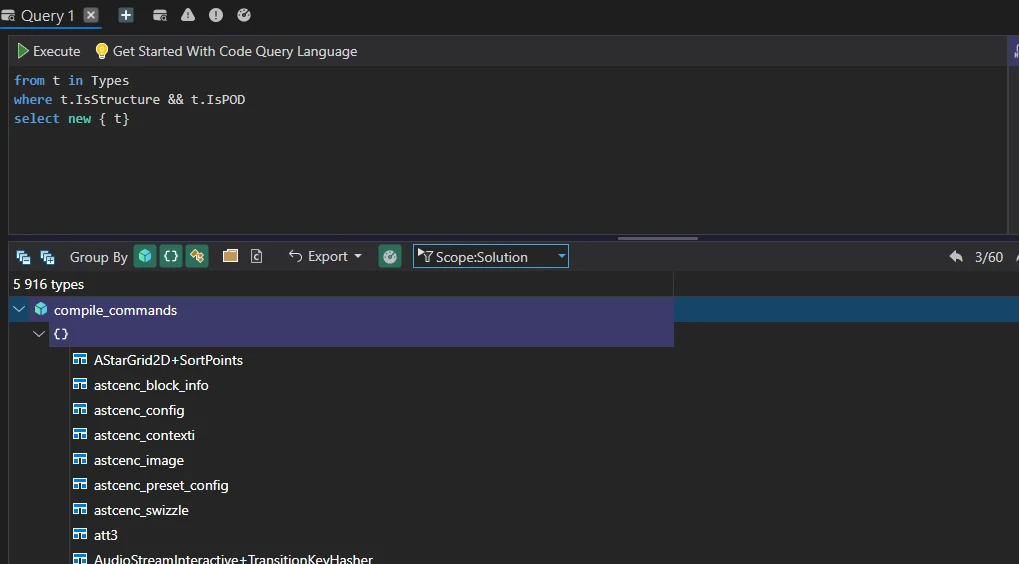
Godot uses the POD types extensively to define the model, so high-frequency rendering and physics data are stored in simple C-style structs without virtual overhead, maximizing CPU cache locality.
The Mystery of Massive Abstract Classes
Analysis flags several abstract server interfaces containing over 100 virtual methods (such as RenderingServer or DisplayServer).
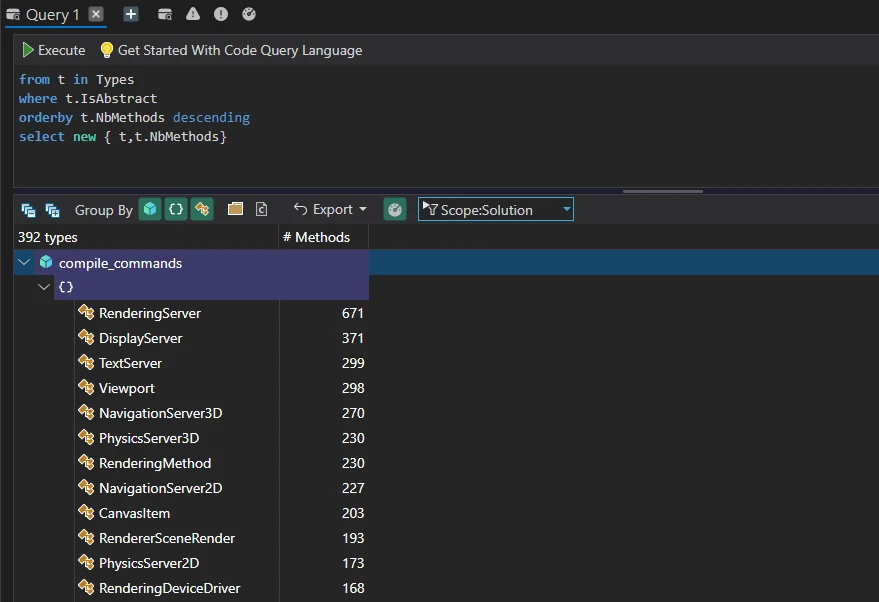
While class design principles advocate for fine-grained interfaces, engine architectures often require centralized abstract classes for specific reasons:
- Single Entry Point Abstraction: Consolidates platform-specific calls (Vulkan, DirectX, Metal, OpenGL) behind a unified interface contract.
- Hot-Swappable Backends: Allows swapping entire subsystem drivers at runtime without modifying consumer code.
- Data-Driven Dispatch: Centralizes resource ID processing to prevent object proliferation across the engine.
While large interfaces require careful maintenance when adding new engine features, they provide the necessary abstraction layer for cross-platform execution.
Custom Containers vs. The C++ STL: Engineering for Games
A striking architectural discovery when static-analyzing Godot’s codebase is the near-total absence of standard C++ STL containers like std::vector, std::string, or std::unordered_map.
While modern C++ idiomatic guidelines advocate for default STL usage, game engines operate under unique constraints where generic STL implementations fall short. Godot resolves this by maintaining its own lean, cache-conscious container suite (Vector<T>, LocalVector<T>, HashMap<K,V>, List<T>, and String).
From the CppDepend matrix we can discover that STL is not widely used:
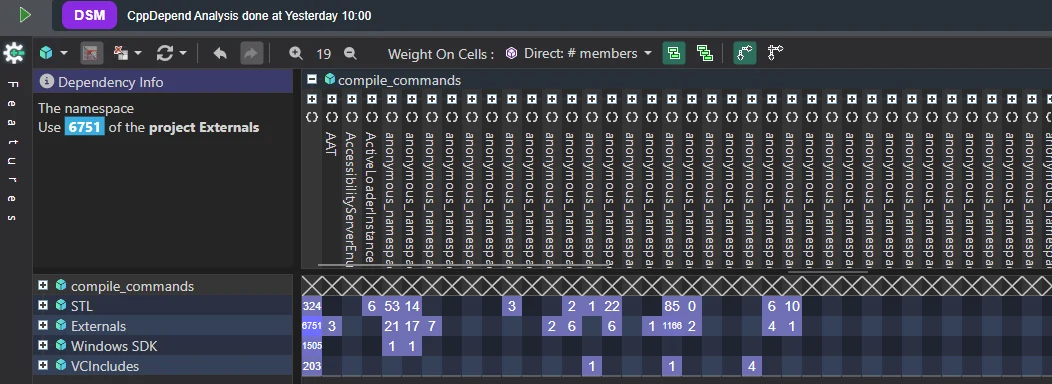
1. Copy-On-Write (COW) Mechanics & Safe Passing
Most core Godot containers—including Vector<T> and String—utilize Copy-on-Write (CowData).
- The Advantage: Passing large arrays, string resources, or node hierarchies across sub-systems or signal callbacks incurs zero copy overhead until a modification occurs.
- Static Analysis Impact: In traditional C++ codebases, passing large
std::vectorobjects by value triggers heavy allocation warnings. In Godot, static analysis reveals that value semantics are intentionally designed to act as lightweight, reference-counted pointers under the hood.
2. Deterministic Memory Allocation & Custom Allocators
std::vector leaves memory allocation strategies to the compiler implementation or runtime defaults, which can lead to heap fragmentation during long gameplay sessions.
- Godot’s custom containers integrate directly with Godot’s custom memory tracking (
Memory::alloc_static,Memory::realloc_static). LocalVector<T>provides a ultra-fast, minimal alternative tostd::vectorspecifically designed for local stack/temporary allocations, stripping out COW overhead where strict ownership and maximum speed are required.
3. Error Handling without Exceptions
Godot explicitly compiles with C++ exceptions disabled (-fno-exceptions) to ensure deterministic performance and smaller binary footprints across export templates (e.g., WebAssembly, Android, iOS, and consoles).
- Standard containers often rely on throwing
std::bad_allocorstd::out_of_range. - Godot’s custom containers handle boundary checks and memory exhaustion gracefully via explicit crash/logging macros (
CRASH_COND,ERR_FAIL_COND), allowing static code analysis tools to trace deterministic error paths across the entire engine.
4. Cache Locality & Open Addressing HashMaps
std::unordered_map uses node-based chaining (bucket lists), which causes frequent cache misses due to pointer chasing across scattered heap memory locations.
- Godot’s custom
HashMap<K,V>uses open addressing with contiguous storage arrays. - This design ensures high CPU L1/L2 cache locality during key lookups—a critical performance win for scene graph lookups, resource caching, and physics spatial queries.
Key Static Analysis Takeaways
| Container Metric | std:: Containers | Godot Custom Containers |
|---|---|---|
| Exception Safety | Expects try/catch & standard exceptions | Exception-free (-fno-exceptions friendly) |
| Pass-by-Value Cost | High (O(N) deep copy) | Low (O(1) via CowData ref-counting) |
| Memory Tracking | Requires custom STL allocators | Native integration with Godot's memory profiler |
| Cache Efficiency | Node-based chaining (std::unordered_map) | Contiguous open-addressing (HashMap) |
Conclusion: A Pragmatic Blueprint for Engine Architecture
Godot Engine is a masterclass in pragmatic, high-performance C++ software engineering. Its lightweight binary size, lightning-fast boot times, and robust cross-platform capability are direct results of clean modular namespace boundaries and cache-conscious POD data structures.
The initial C rating from automated analysis tools highlights the danger of applying generic or safety-critical compliance rules (like MISRA) to game engine codebases. Once those false alarms are stripped away, Godot proves to be a well-designed and exceptionally maintained system.
Where Godot shows structural friction, it falls into classic game engine trade-offs:
- Monster Methods & High Complexity: Localized primarily in low-level drivers and parsing hot paths where raw performance and state handling take priority over strict method brevity.
- Large Types & Monolithic Abstract Interfaces: Massive server types like RenderingServer violate the Interface Segregation Principle on paper, but they serve a crucial architectural purpose—providing a unified, hot-swappable entry point for Vulkan, DirectX, Metal, and OpenGL.
👉 Download CppDepend and explore your own codebase like we did with Godot