
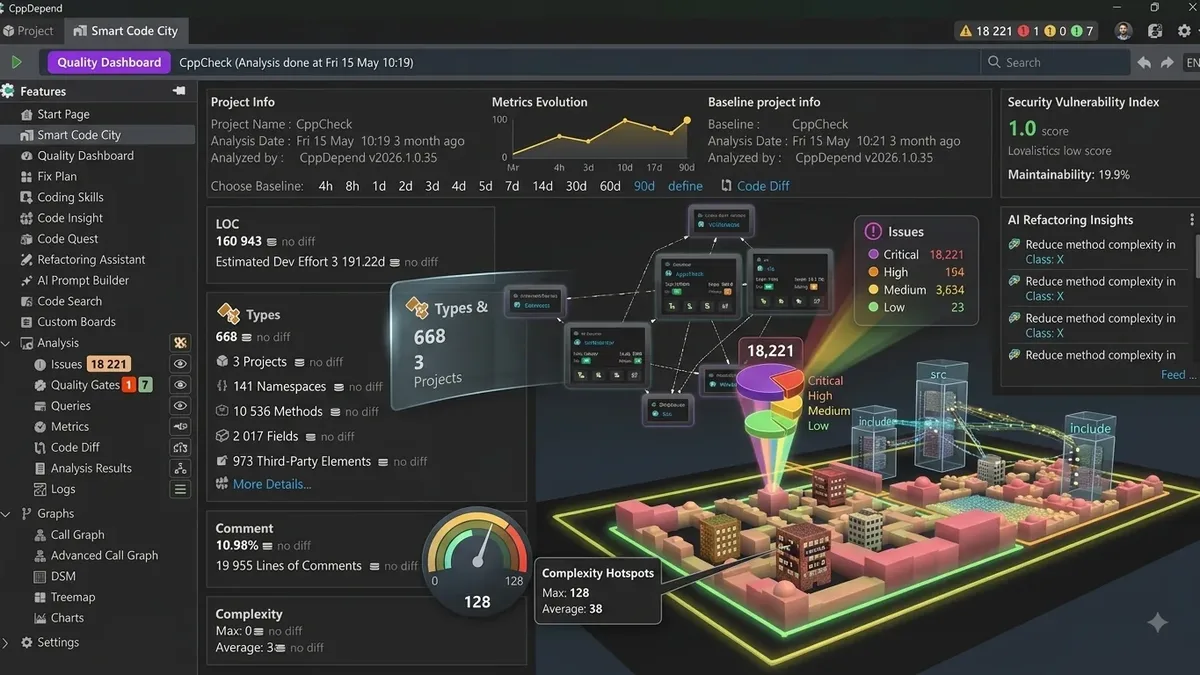
A major update that brings cross-language architecture controls, 3D Smart Code City, AI Prompt Builder, and native IDE plugins.
Managing software architecture and preventing technical debt in enterprise monorepos is hard — especially when bridging native C/C++ modules with JVM-based services or interfaces. As systems scale over time, structural boundaries erode. Circular dependencies creep in, build times degrade, and code complexity metastasizes into fragile “God classes” that developers fear to refactor.
With the release of CppDepend 2026.2, we are taking a massive leap forward in unifying static analysis, 3D code visualization, AI agent workflows, and automated quality gates across multiple software ecosystems.
Important Note: CppDepend 2026.2 is completely free for personal and non-commercial use.
Here is an in-depth breakdown of what’s inside this release and how it changes the way engineering teams inspect, manage, and modernize software architecture.
1. Multi-Language Engine: Bridging C, C++, and Java
Static analysis shouldn’t stop at language boundaries. Modern systems are rarely written in a single language; high-performance C/C++ engines frequently interface with Java orchestrators, microservices, or enterprise desktop clients.
In CppDepend 2026.2, our static analysis parsing engine natively analyzes Java codebases alongside C and C++.
- Cross-Language Architectural Controls: Track cyclic dependencies, component coupling, and structural technical debt across your multi-language repositories in a single unified model.
- Unified Metrics: Apply uniform static analysis metrics across both native and JVM-based components. Measure Cyclomatic Complexity, Lack of Cohesion of Methods (LCOM), Efferent/Afferent Coupling (Ce/Ca), and the Maintainability Index side-by-side.
- Safety & Compliance Standards: Enforce rules automatically across international software standards, including MISRA C/C++, CERT C/C++, CWE, and Java security guidelines.
By parsing compiled assemblies, Java bytecode, and source ASTs, CppDepend provides an unbiased, mathematically grounded view of your entire system’s health.
2. Smart Code City: 3D Architectural Visualization
Understanding a codebase with hundreds of thousands — or millions — of lines of code is nearly impossible through raw text or static file trees alone. When onboarding new developers or conducting enterprise architectural reviews, developers benefit from spatial visualization.
CppDepend 2026.2 introduces Smart Code City alongside our interactive Dependency Matrices and Treemaps:

- Interactive 3D Code City: Explore your codebase as a virtual 3D city. Every building represents a type or class, districts represent namespaces or packages, and building heights and colors immediately reveal complexity hotspots and technical debt.
- Instant Hotspot Detection: Fly through your system visually to identify giant “God classes,” high coupling, and fragile modules before they break production environments.
- Dependency Structure Matrix (DSM): Dissect complex component relationships with a high-density matrix view that instantly highlights circular dependencies, component layering violations, and improper package coupling.
3. AI Workflows: Code Quest & Prompt Builder
Static analysis shouldn’t just point out problems; it should accelerate the path to fixing them. One of the biggest challenges with generative AI tools (like Copilot, ChatGPT, or Claude) is context window pollution and structural hallucination. LLMs lack a global AST graph of your codebase.
CppDepend 2026.2 bridges static analysis with LLMs through two dedicated AI-assisted architectural tools:
- Code Quest (Ask Questions to Your Codebase): Query types, methods, namespaces, dependencies, and metrics using natural language, backed by the CppDepend static analysis engine. Get precise answers, issue distributions, and technical debt estimates in seconds.
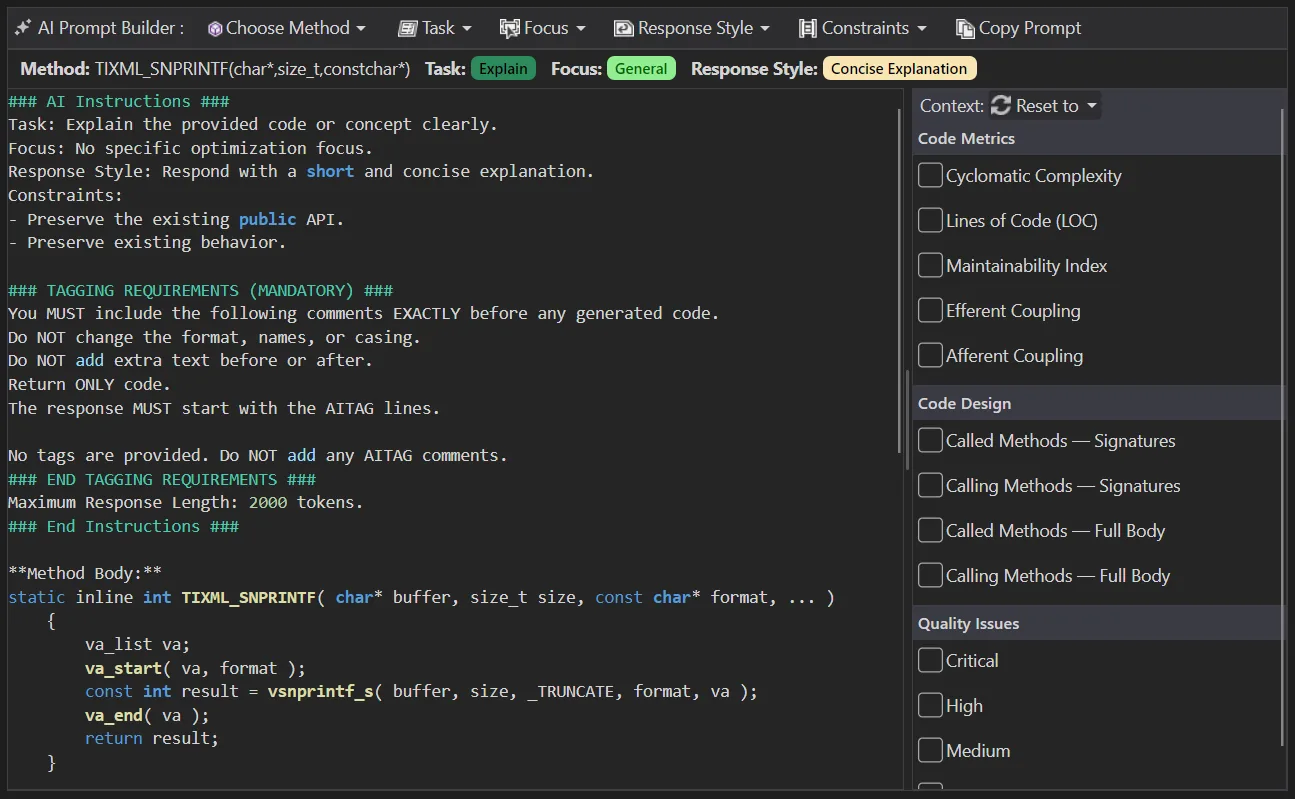
- Prompt Builder: Bridge static analysis with LLMs. Prompt Builder extracts exact AST context, call graphs, rule violations, and severity data from CppDepend to generate optimized, highly grounded prompts for AI coding assistants. Fix architectural flaws faster without hallucinated context.
4. Custom Quality Boards & CQLinq Engine
At the core of CppDepend is CQLinq (Code Query LINQ), an industry-first query language that lets you write custom rules directly using C# query syntax. Instead of relying on rigid, predefined rules, you can query your code like a database:
// Example: Find high-complexity methods that lack unit test coverage
from m in Methods
where m.CyclomaticComplexity > 15 && m.PercentageCodeCoverage < 50
select new { m, m.CyclomaticComplexity, m.PercentageCodeCoverage }
In 2026.2, we’ve expanded this foundation with:
- Code Insight: Get a single unified view per code element (assembly, namespace, type, or method). Instantly answer “Is this code healthy?” with size metrics, technical debt impact, test coverage, and call graph tabs in one screen.
- Custom Boards: Compose custom, tailored dashboards using rule widgets, trend charts, and Quality Gates. Define strict go/no-go thresholds on build pipelines to stop technical debt before it reaches the main branch.
5. Multi-IDE & Multi-Platform Integration
Architectural enforcement only works if it reaches developers where they actually write code. CppDepend 2026.2 fits seamlessly into modern enterprise development setups:
- IDEs Supported: Visual Studio 2026, VS Code, JetBrains CLion, JetBrains IntelliJ IDEA, and Eclipse.
- Operating Systems: Runs natively across Windows, macOS, and Linux.
- CI/CD Integration: Integrates into GitHub Actions, Azure DevOps, GitLab CI, and Jenkins to fail builds automatically when quality gates or compliance rules are breached.
- Global Teams: Includes a multi-language UI (English, French, German, Chinese, Japanese) for distributed engineering organizations.
6. Automated Technical Debt Estimation & Remediation Cost
Quantifying technical debt for non-technical stakeholders or engineering management is historically difficult. Developers know code smells exist, but leadership requires concrete financial or hourly estimates to prioritize refactoring tasks over new feature development.
CppDepend 2026.2 calculates Technical Debt and Remediation Cost automatically for every rule violation:
- Debt Ratio & Rating (A to E): Measures the effort required to fix accumulated code smells relative to the total effort required to write the codebase from scratch.
- Actionable Remediation Effort: Every static analysis rule includes a default time-to-fix estimate (e.g., 15 minutes to reduce coupling on a method, 2 hours to break up a circular dependency), which can be fully customized based on your team’s velocity.
- Debt Interest Tracking: See how much extra time your engineering team wastes daily maintaining debt-heavy modules versus the upfront cost of fixing them.
7. Continuous CI/CD Integration & Automated Quality Gates
Preventing architectural decay requires automated controls at the pull request level. Manual code reviews frequently miss subtle architectural creep, such as a developer introducing a dependency link that creates a giant circular loop across modules.
CppDepend 2026.2 acts as an automated gatekeeper in your deployment pipeline:
- Seamless CI/CD Integration: Runs headlessly inside GitHub Actions, Azure DevOps, GitLab CI, Bitbucket Pipelines, and Jenkins.
- Strict Quality Gates: Define failure criteria for builds. Block pull requests if new code introduces circular dependencies, drops unit test coverage below a required threshold, or adds more than 2 hours of technical debt in a single commit.
- Baseline Comparison (Diff Analysis): Compare any current build against a historical baseline (e.g., your last release or main branch). Instantly highlight newly introduced issues versus legacy debt, ensuring developers are only held accountable for code they touched.
Transforming Technical Debt into Actionable Engineering
Technical debt isn’t just a subjective feeling — it is a measurable engineering liability. Whether you are modernizing a 20-year-old C++ monolith, maintaining complex Java services, or establishing automated quality gates in CI/CD, CppDepend 2026.2 gives you the visibility and control needed to build sustainable software.