

The Internet of Things (IoT) refers to the network of physical objects—devices, vehicles, buildings, and other items—embedded with sensors, software, and other technologies to connect and exchange data with other devices and systems over the internet. IoT encompasses a wide range of applications, from consumer gadgets to industrial systems, transforming how we interact with the physical world.
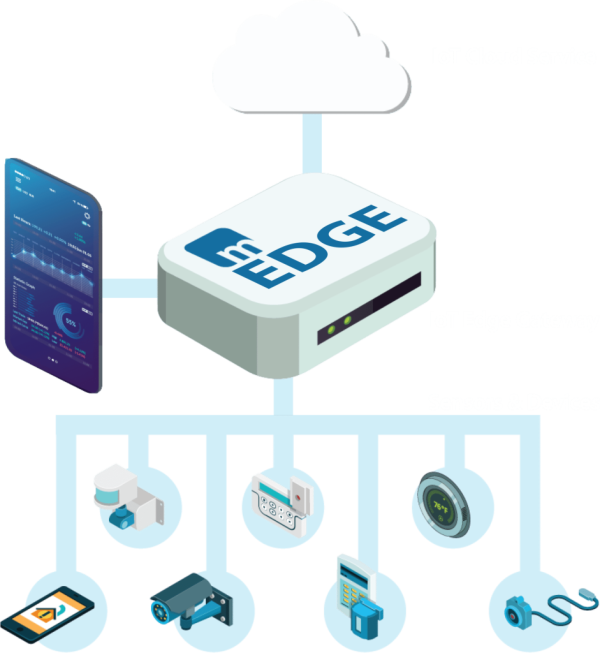
Key Components of IoT
Devices and Sensors
- Sensors: Capture data from the environment, such as temperature, humidity, light, motion, and more.
- Actuators: Perform actions based on commands, like turning on lights, opening doors, or adjusting thermostats.
- Embedded Systems: Devices with integrated computing capabilities, such as smart thermostats, wearables, and industrial controllers.
Connectivity
- Networks: IoT devices communicate over various networks, including Wi-Fi, Bluetooth, Zigbee, cellular (4G/5G), LoRaWAN, and more.
- Protocols: Standard protocols like MQTT, HTTP/HTTPS, CoAP, and WebSockets enable data exchange between devices and servers.
Data Processing
- Edge Computing: Processing data at or near the source (on the device) to reduce latency and bandwidth use.
- Cloud Computing: Centralized processing and storage of data, often involving large-scale analytics and machine learning.
Security
Measures to protect data and devices from unauthorized access and cyber threats.
User Interface
- Applications: Mobile and web applications that allow users to interact with and control IoT devices.
- Dashboards: Visual interfaces for monitoring and managing connected devices and data.
Use Cases:
- Home Automation: Control and automate home devices.
- Industrial IoT: Monitor and control industrial machinery.
- Smart Cities: Manage and control smart city infrastructure.
- Health Monitoring: Collect and process health-related data from medical devices.
In C++, many libraries can help you implement an IoT application, but most operate at a relatively low level. For a high-level SDK, Macchina.io is an excellent choice, especially if you seek a robust framework that simplifies IoT application creation.
Like the C++ POCO library, Macchina.io EDGE is well designed and built with a modular, extensible architecture.
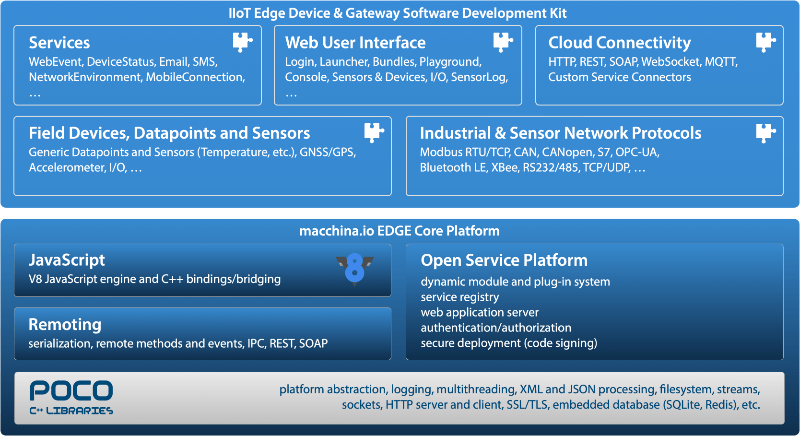
Here are some of the key characteristics of macchina.io’s design:
- Modularity: Macchina.io is highly modular, allowing developers to use only the components they need.
- C++ and JavaScript: Supports development in both C++ and JavaScript, providing flexibility for developers.
- Device Management: Includes tools for device management and communication.
- Connectivity: Supports multiple protocols, including HTTP, MQTT, WebSockets, and CoAP, making it versatile for various IoT use cases.
- Data Handling: Provides components for data acquisition, storage, and processing.
- Automation: Includes an automation engine that allows for creating rule-based automation tasks.
- Security: Focuses on security with components for encryption, authentication, and secure communication.
Benefits of using Macchina.io EDGE
- Reduces Complexity: Provides high-level APIs in JavaScript and C++, simplifying IoT application development.
- Focus on Core Competencies: Saves time by handling infrastructure and low-level code, allowing developers to focus on unique product features.
- Hardware Independence: Allows writing hardware-agnostic applications, easing platform switches.
- High Performance and Low Footprint: Ideal for demanding applications and cost-efficient devices.
- Modernizes Legacy Code: Facilitates future-proofing of existing C++ and C code.
How to Get Started with Macchina.io Edge
If you want to explore Macchina.io Edge capabilities, you first need to create a bundle. Indeed, Macchina.io EDGE is completely implemented in a modular, plug-in based architecture, using a C++ framework named Open Service Platform (OSP). Therefore, virtually all code that runs within macchina.io EDGE comes from a plug-in, or bundle, as it's called in OSP and macchina.io EDGE.
A bundle is essentially a directory with a specific structure or, more commonly, a ZIP archive (with extension .bndl) containing that directory hierarchy. A bundle contains mandatory metadata (the so-called manifest), as well as configuration files, dynamic libraries, and other resources like HTML files, images or stylesheets.
Generally, there are two ways to run code within a bundle. First, a bundle can provide a BundleActivator class, which must be a subclass of Poco::OSP::BundleActivator. In addition to implementing the class, it must also be declared in the bundle's meta information, the so-called bundle manifest.
Second, a bundle can also implement one or more extension points. An extension point is, generally speaking, a hook defined by a bundle, that another bundle can hook itself in to.
Here's a detailled documentation that helps you create your first bundle.
To summarize, Macchina.io EDGE is a powerful IoT software toolkit designed to streamline the development of edge devices and gateways. With high-level APIs in JavaScript and C++, it reduces complexity and allows developers to focus on their core competencies. The platform provides hardware independence, enabling easy migration across different systems, while offering high performance with a small footprint—ideal for demanding applications. Additionally, it supports the modernization of legacy code, helping to future-proof existing applications.