
Firmware you can certify. Architecture you can trust.
CppDepend gives embedded teams MISRA, CERT and AUTOSAR C++14 checks, architecture control and CI quality gates — running 100% on-premise, so your source code never leaves your network.
- 99 MISRA C:2012 rules
- MISRA C++:2023 · AUTOSAR · CERT · CWE
- Air-gap ready
- Windows · Linux · macOS
- UI in 7 languages
Trusted by engineering teams at
Embedded code plays by different rules
Generic code-quality tools were built for web services. Firmware lives under hard constraints, long lifecycles and certification audits — CppDepend is built for that.
Every byte and cycle counts
Spot oversized functions, deep call chains and complexity hotspots before they reach the target.
Certification pressure
ISO 26262, IEC 61508, DO-178C and IEC 62304 audits demand evidence. Produce it continuously, not the week before the audit.
Decade-long lifecycles
Products live 10 to 20 years. Stop architectural drift and keep legacy firmware maintainable across hardware generations.
Many boards, one codebase
Keep HAL, drivers and application layers cleanly separated so porting to new silicon stays predictable.
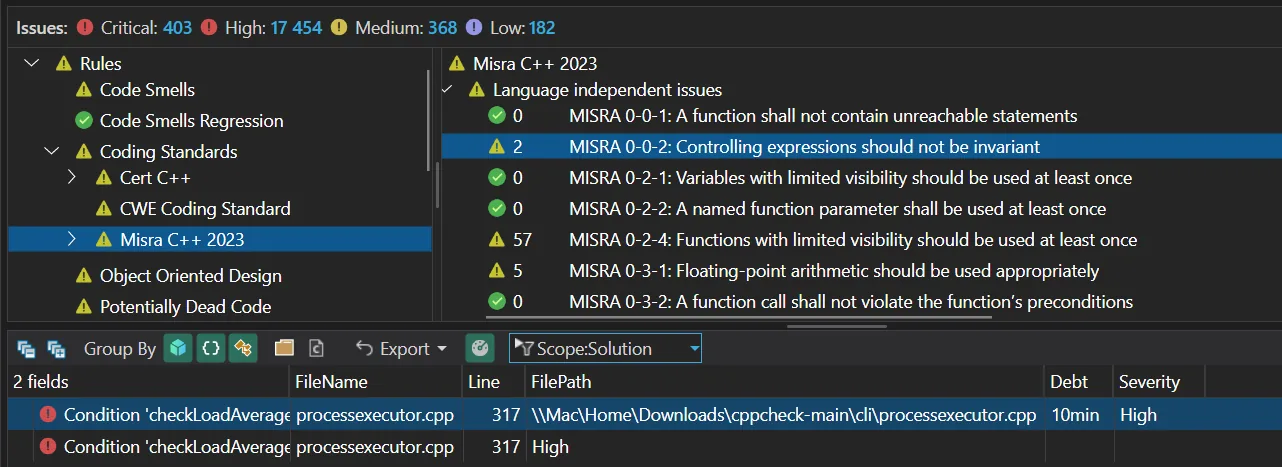
Safety and security standards, built in
Select your rule sets when you create the project. Every violation is traced to the exact file and line, with the rule that explains it.
From first analysis to lasting code quality
Prove compliance on every commit
Run MISRA, CERT and AUTOSAR checks locally and in CI, and focus your team on what changed instead of re-reviewing thousands of legacy findings.
- MISRA, CERT and AUTOSAR results, traced to the exact line of code
- Separate new violations from the legacy baseline
- Include rule groups in the HTML report for auditors
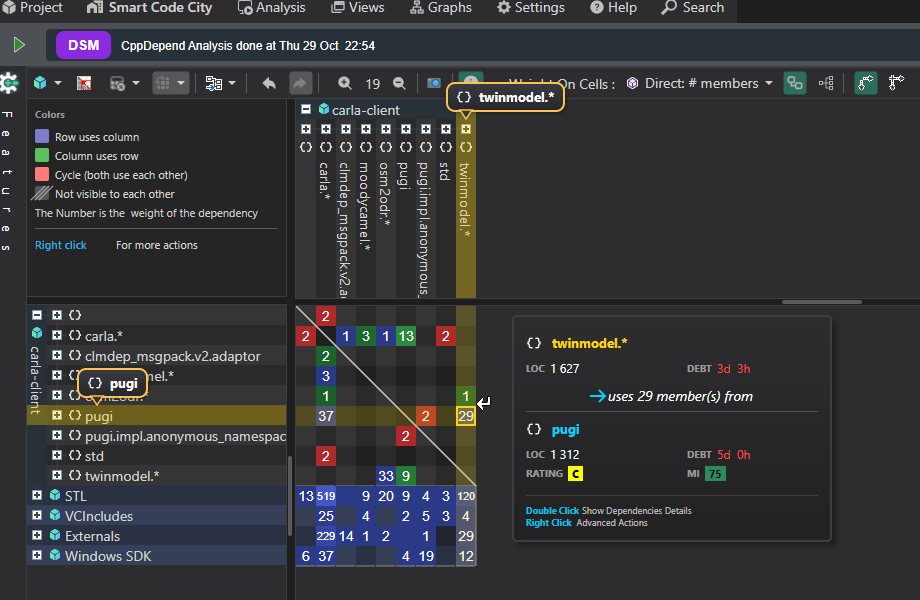
See your layers — and the cycles between them
The dependency matrix shows every coupling between modules at a glance. Spot when application code reaches into the HAL, or two drivers depend on each other.
- Dependency matrix and graph across modules, namespaces and files
- Detect cyclic dependencies before they spread
- Turn your layering into rules that run on every build
Encode your own embedded rules
Every team has rules no standard covers. With Code Quest you write them as queries over your code model and run them like any built-in rule.
- Size and complexity budgets for ISRs and control loops
- Forbidden dependencies between layers or components
- Results in the IDE, in reports and in quality gates
// ISRs must stay short and predictable
warnif count > 0
from m in Application.Methods
where m.NameLike("ISR|IRQHandler")
   && (m.NbLinesOfCode > 30
       || m.CyclomaticComplexity > 8)
select new { m, m.NbLinesOfCode,
             m.CyclomaticComplexity }
Gate every build, on every target
Quality gates turn your thresholds into pass/fail decisions in the pipeline, so regressions are caught at the merge request, not on the test bench.
- Jenkins, GitLab CI, GitHub Actions and Azure DevOps
- Fail the build on new critical issues or debt
- Track trends across releases and product variants

No new build system. No workflow change.
CppDepend parses your code with Clang from the build description you already have, and brings findings into the tools your team already uses.
Build inputs
IDEs
Import your analyzers
Your code is your IP. It never leaves your network.
Source code is often your most valuable — and most regulated — asset. CppDepend analyzes it where it lives.
100% on-premiseRuns on your workstations and build servers. No source upload.
Air-gap readyWorks fully offline — ideal for defense, medical and secure labs.
No cloud accountNothing to provision, nothing to approve with your security team.
Cleaner firmware architecture — modules refactored and decoupled with confidence, then reused faster across product variants.
A maker of smart controllers for factory automation and heavy machinery used CppDepend to tame timing-sensitive firmware for pressure control, fault detection and industrial protocols.
Read the full case studyQuestions embedded teams ask us
Which coding standards are supported out of the box?
Built-in rule sets cover MISRA C, MISRA C++, AUTOSAR C++14, CERT C, CERT C++ and CWE. Any other standard or internal guideline is enforced with custom Code Quest rules, architecture validation and CI quality gates.
Can we enforce our own embedded rules?
Yes. Code Quest lets you write project-specific rules — for example size and complexity limits for interrupt handlers, or forbidden dependencies between layers — and run them on every build.
Does our source code ever leave our network?
No. CppDepend runs entirely on your workstations and build servers. It works fully offline and in air-gapped labs — no upload, no cloud account.
Can it analyze our build?
CppDepend parses your code with Clang from your existing build description: Visual Studio solutions, a CMake JSON compilation database, Makefiles, or the Build Monitor, which records the compiler calls of your build.
Which operating systems and languages are supported?
CppDepend runs on Windows, Linux and macOS, and its user interface is available in English, German, French, Spanish, Chinese, Japanese and Korean.
How can we evaluate CppDepend on our code?
Start a 30-day full-featured trial, or request a guided PoC: we run CppDepend on your codebase with you and review the results together.
CppDepend works wherever C and C++ run
Not quite your industry? The same analysis engine serves every kind of C/C++ codebase.
See what CppDepend finds in your firmware
Analyze your own codebase in minutes — coding standards, architecture and quality gates included.
Full-featured trial · No credit card required · Runs on-premise