
Low-latency code that stays secure and audit-ready.
CERT C/C++ and CWE checks, complexity control and architecture validation for trading platforms, risk engines, core banking and payments — without your code leaving the building.
- CERT C/C++ · CWE built in
- Audit-ready reports
- 100% on-premise
- Windows · Linux · macOS
- UI in 7 languages

Trusted by engineering teams at
Microseconds matter. So do auditors.
Financial C++ must be fast, fault-tolerant and secure — while regulators expect traceability and maintainable, well-controlled software.
Low latency
High-complexity methods on the order path cost latency and stability.
Layered legacy systems
Core banking and trading stacks carry decades of deep, tangled dependencies.
Regulatory pressure
PCI-DSS, SOX and GDPR all require secure, maintainable and auditable software.
Security and privacy
Unsafe pointer usage, bounds and exception-safety issues are attack surface.
Secure coding rules, built in
Financial systems are not governed by MISRA — but they must be secure and correct. Start with CERT and CWE, then add your internal rules.
From first analysis to lasting code quality
Harden the code continuously
Exception safety, bounds checking and pointer usage monitored on every build — not reviewed manually once a quarter.
- CERT C/C++ and CWE results, traced to the exact line of code
- Separate new violations from the legacy baseline
- Include rule groups in the HTML report for auditors

Keep the hot path lean
Set complexity budgets for order routing, matching and pricing code — and get alerted the moment a change breaks them.
- Complexity budgets for latency-critical code
- Forbidden dependencies between tiers
- Results in the IDE, in reports and in quality gates
// Order path: complexity budget
warnif count > 0
from m in Application.Namespaces
   .WithNameLike("Order").ChildMethods()
where m.CyclomaticComplexity > 12
select new { m, m.CyclomaticComplexity,
             m.NbLinesOfCode }
Control dependencies across tiers
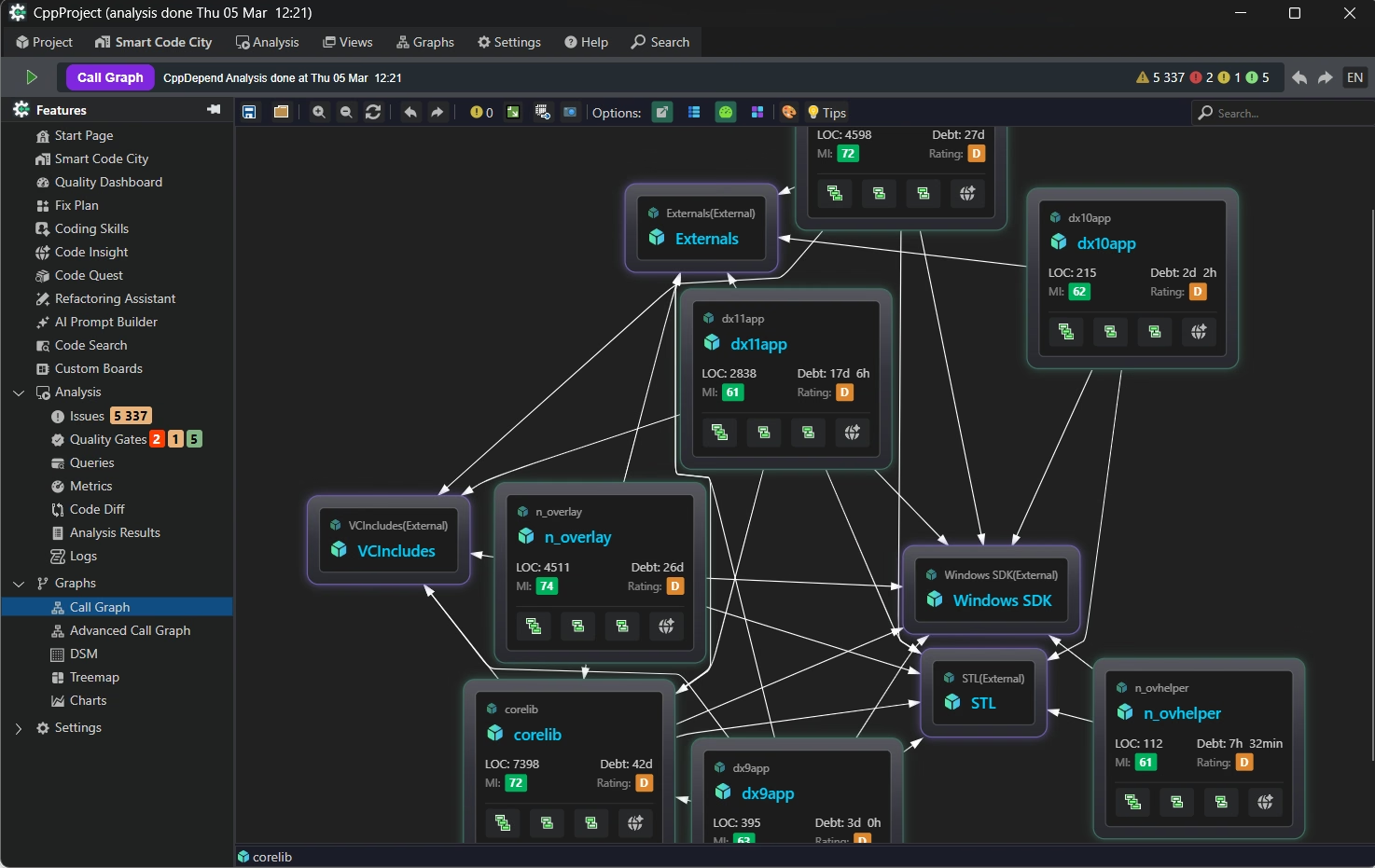
Prevent architectural violations in multi-tier systems — and see what a change will impact before it ships.
- Dependency matrix and graph across services and libraries
- Detect cycles and forbidden couplings
- Impact analysis before risky changes
Audit-ready pipelines
Quality gates and trend reports enforce your bar on every deployment and document code health for auditors.
- Jenkins, GitLab CI, GitHub Actions and Azure DevOps
- Fail the build on new critical issues
- Track debt and security trends over releases

No new build system. No workflow change.
CppDepend parses your code with Clang from the build description you already have, and brings findings into the tools your team already uses.
Build inputs
IDEs
Import your analyzers
Your code is your IP. It never leaves your network.
Source code is often your most valuable — and most regulated — asset. CppDepend analyzes it where it lives.
100% on-premiseRuns on your workstations and build servers. No source upload.
Air-gap readyWorks fully offline — ideal for defense, medical and secure labs.
No cloud accountNothing to provision, nothing to approve with your security team.
Security hardening — exception safety, bounds checking and pointer usage monitored continuously, not reviewed manually.
A firm running a proprietary trading platform processing thousands of orders per second, integrated with multiple market APIs and internal risk engines.
Read the full case studyQuestions financial teams ask us
Which security standards are built in?
CERT C, CERT C++ and CWE are built in. OWASP-inspired or internal security rules are enforced with custom Code Quest rules.
Can CppDepend help with PCI-DSS or SOX audits?
It provides objective, repeatable evidence of code quality and secure-coding checks — rule results, trends and HTML reports you can add to your audit documentation.
Does our source code ever leave our network?
No. CppDepend runs entirely on your workstations and build servers. It works fully offline and in air-gapped labs — no upload, no cloud account.
Can it analyze our build?
CppDepend parses your code with Clang from your existing build description: Visual Studio solutions, a CMake JSON compilation database, Makefiles, or the Build Monitor, which records the compiler calls of your build.
Which operating systems and languages are supported?
CppDepend runs on Windows, Linux and macOS, and its user interface is available in English, German, French, Spanish, Chinese, Japanese and Korean.
How can we evaluate CppDepend on our code?
Start a 30-day full-featured trial, or request a guided PoC: we run CppDepend on your codebase with you and review the results together.
CppDepend works wherever C and C++ run
Not quite your industry? The same analysis engine serves every kind of C/C++ codebase.
See what CppDepend finds in your trading or banking code
Analyze your own codebase in minutes — coding standards, architecture and quality gates included.
Full-featured trial · No credit card required · Runs on-premise