

Almost all C++ developers probably know the LLVM infrastructure and the Clang compiler. But how many know that Chris Lattner is their creator, and that he was only 25 years old at the time? How is that possible? I remember that when I was 25, I spent my time trying to understand the C++ basics :)
The story begins with a thesis
In late 2000, Lattner joined the University of Illinois at Urbana-Champaign as a research assistant and M.Sc. student. While working with Vikram Adve, he designed and began implementing LLVM, an innovative infrastructure for optimizing compilers, which was the subject of his 2002 M.Sc. thesis. He completed his Ph.D. in 2005, researching new techniques for optimizing pointer-intensive programs and adding them to LLVM.
Here’s the motivation behind the LLVM design, from his thesis abstract:
Modern programming languages and software engineering principles are causing increasing problems for compiler systems. Traditional approaches, which use a simple compile-link-execute model, are unable to provide adequate application performance under the demands of the new conditions. Traditional approaches to interprocedural and profile-driven compilation can provide the application performance needed, but require infeasible amounts of compilation time to build the application.This thesis presents LLVM, a design and implementation of a compiler infrastructure which supports a unique multi-stage optimization system. This system is designed to support extensive interprocedural and profile-driven optimizations, while being efficient enough for use in commercial compiler systems.The LLVM virtual instruction set is the glue that holds the system together. It is a low-level representation, but with high-level type information. This provides the benefits of a low-level representation (compact representation, wide variety of available transformations, etc.) as well as providing high-level information to support aggressive interprocedural optimizations at link- and post-link time. In particular, this system is designed to support optimization in the field, both at run-time and during otherwise unused idle time on the machine.
In short, the idea behind LLVM is to use the LLVM Intermediate Representation (IR), which is similar to Java bytecode or .NET IL.
LLVM IR is designed to host mid-level analyses and transformations that you find in the optimizer section of a compiler. It was designed with many specific goals in mind, including supporting lightweight runtime optimizations, cross-function/interprocedural optimizations, whole program analysis, and aggressive restructuring transformations, etc. The most important aspect of it, though, is that it is itself defined as a first class language with well-defined semantics.
Let’s consider a relatively straightforward function that takes three integer parameters and returns an arithmetic combination of them.
int mul_add(int x, int y, int z) {
  return x * y + z;
}
The LLVM IR for this function looks like:
define i32 @mul_add(i32 %x, i32 %y, i32 %z) {
entry:
  %tmp = mul i32 %x, %y
  %tmp2 = add i32 %tmp, %z
  ret i32 %tmp2
}
Returning to the goal of this thesis, which focuses on optimization. To explain this compiler phase, I can’t say it better than Chris Lattner, the father of LLVM, in this post:
“To give some intuition for how optimizations work, it is useful to walk through some examples. There are lots of different kinds of compiler optimizations, so it is hard to provide a recipe for how to solve an arbitrary problem. That said, most optimizations follow a simple three-part structure:
- Look for a pattern to be transformed.
- Verify that the transformation is safe/correct for the matched instance.
- Do the transformation, updating the code.
LLVM and Clang as infrastructure to build tools
A major design concept for Clang is its use of a library-based architecture. In this design, various parts of the front-end can be cleanly divided into separate libraries which can then be mixed up for different needs and uses. In addition, the library-based approach encourages good interfaces and makes it easier for new developers to get involved (because they only need to understand small pieces of the big picture).
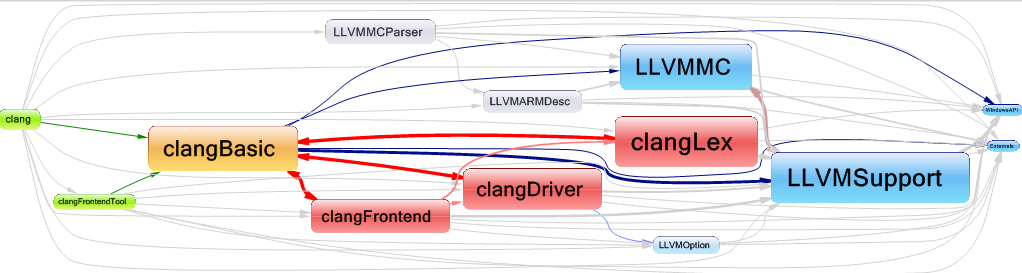
The design of LLVM/Clang makes it a powerful infrastructure for building tools, thanks to its library-based architecture, which makes it easier to reuse components and integrate new features into other projects.
Many tools are based on LLVM and Clang, including clang-tidy, clang-query, CppDepend and more.
Clang is always up to date with new standards
Clang consistently keeps pace with new standards; furthermore, it always provides experimental support for upcoming features. The current version has experimental support for some proposed features of the C++ standard following C++17, provisionally named C++2a. Note that support for these features may change or be removed without notice, as the draft C++2a standard evolves.
You can use Clang in C++2a mode with the -std=c++2a option.
| Language Feature | C++2a Proposal | Available in Clang? |
|---|---|---|
| Default member initializers for bit-fields | P0683R1 | Clang 6 |
| const&-qualified pointers to members | P0704R1 | Clang 6 |
| Allow lambda-capture [=, this] | P0409R2 | Clang 6 |
| __VA_OPT__ for preprocessor comma elision | P0306R4 | Clang 6 |
| Designated initializers | P0329R4 | Partial (extension) |
| Initializer list constructors in class template argument deduction | P0702R1 | Clang 6 |
| Access checking on specializations | P0692R1 | Partial |
Clang is now adopted by many big companies, including Google, Microsoft and of course Apple, which has used it from the beginning.
The LLVM infrastructure can be used to implement compilers for many programming languages and interpreters. For example, PostgreSQL now uses the LLVM JIT to optimize query execution, as specified here:
Currently, PostgreSQL executes SQL queries using the interpreter, which is quite slow. However, significant speedup can be achieved by compiling query "on-the-fly" with LLVM JIT: this way it's possible for given SQL query to generate more effective code, which is specialized using the information known at run time, and then additionally optimize it with LLVM. This approach is especially important for complex queries, where performance is CPU-bound.
Thanks to all the LLVM/Clang developers, and special thanks to Chris Lattner, who initiated the revolution and gave us a powerful infrastructure for developing meaningful tools.
Finally, a message to young developers: be the next Chris Lattner and start a revolution in the programming world :)